

 TradeBrix
 January 28, 2026
 6 min read
Best Prop Firm Software in 2026: Why TradeBrix Outperforms Competitors
Best Prop Firm Software in 2026: Why TradeBrix Outperforms Competitors

Introduction
Choosing the best prop firm software in 2026 is not just a technical decision. It is a strategic one.
Infrastructure now determines whether a firm scales efficiently to thousands of active traders or stalls due to manual bottlenecks, fragmented systems, and inconsistent rule enforcement. After the 2025 industry shake-out, the firms that continued to grow were those operating on automation-first, modular platforms rather than patched-together legacy stacks.
Modern prop firm software must handle real-time risk monitoring, multi-asset integrations across futures, forex, and crypto, automated onboarding workflows, and reliable payout systems. It must also improve trader retention, not just administrative efficiency.
PropBrix by TradeBrix was built specifically for evaluation-based prop firms. It is not adapted from broker infrastructure or retrofitted from a generic CRM. It functions as a unified operating system designed to support serious operators as they scale.
This guide outlines what leading platforms now deliver and why TradeBrix consistently outperforms typical alternatives.
The Standard for Prop Firm Software Has Changed
A few years ago, firms could operate with basic admin dashboards and manual reconciliation processes. That approach no longer works at scale.
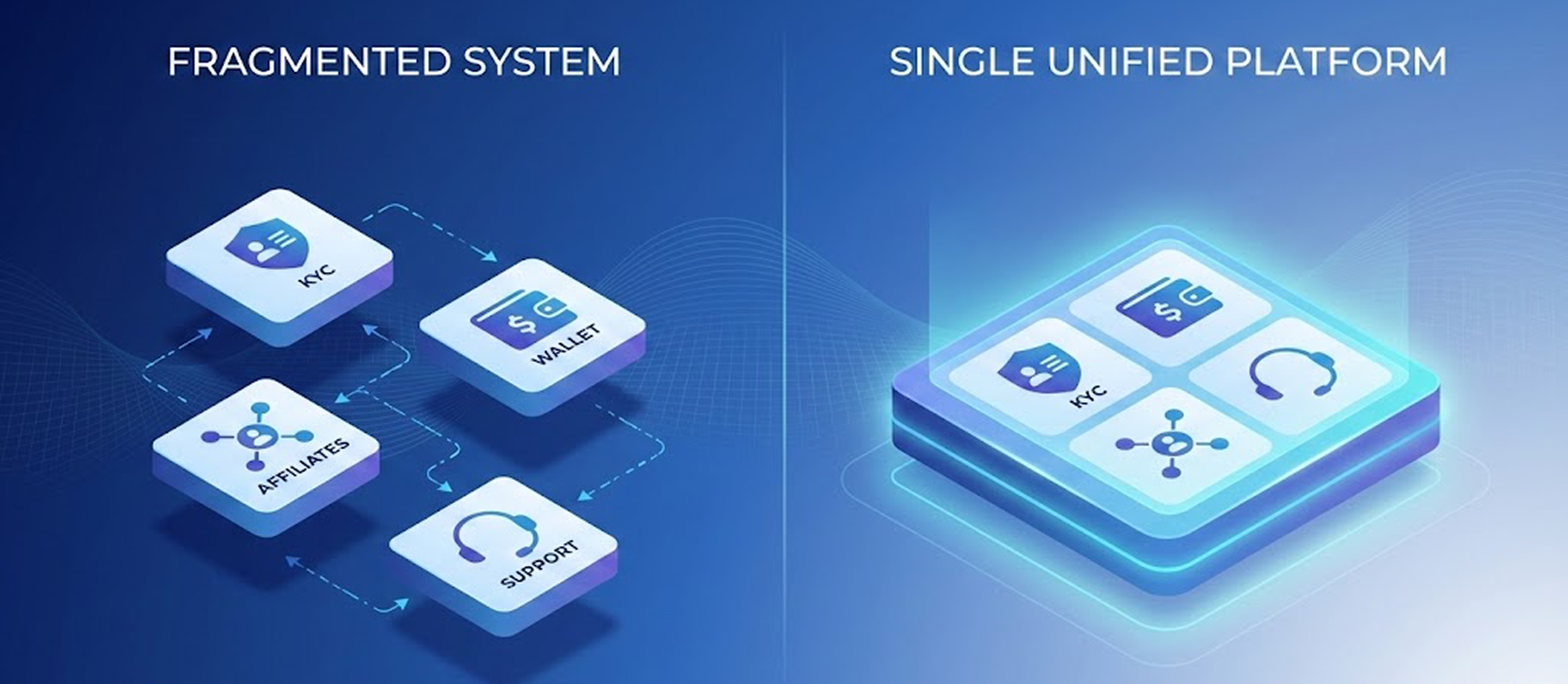
Modern platforms must unify onboarding, compliance, risk monitoring, payouts, affiliate tracking, and reporting inside a single system. When these functions are split across multiple tools, complexity rises quickly. Support tickets increase. Data mismatches appear. Scaling becomes slower and more expensive.
Firms running on automation-driven platforms often report reducing manual operational workload by 70–80%. That efficiency difference compounds significantly once trader numbers move into the thousands.
The gap between adequate software and infrastructure-grade software is now measurable.
Core Features Every Leading Platform Must Provide
Integrated Trader CRM and Onboarding
Onboarding friction directly affects conversion rates. A strong system enables automated identity verification, fast account creation, and seamless challenge enrollment within minutes.
More importantly, trader data is centralized. Operators can review performance metrics, account status, payout history, and compliance logs in one place. Without centralization, oversight becomes reactive rather than structured.
Real-Time Dashboards
Transparency benefits both firms and traders.
Administrators need live visibility into exposure levels, breach events, and payout queues. Traders require accurate tracking of drawdown limits, profit targets, and historical performance data.
Clear dashboards reduce disputes and build confidence in rule enforcement.
AI-Powered Risk Monitoring
Manual monitoring cannot scale efficiently.
Advanced platforms now incorporate predictive analytics, real-time anomaly alerts, and performance pattern detection. These tools allow firms to monitor large trader bases consistently and apply rules uniformly.
Operators leveraging structured analytics alongside well-designed challenge frameworks report pass-rate improvements reaching 15–35%. These improvements stem from clarity and optimized rule structures rather than relaxed standards.
Flexible Challenge Engines
The ability to adjust rule sets without rebuilding infrastructure is essential.
- Fixed and trailing drawdown
- One-phase and two-phase models
- Instant funding options
- Time-limited or unlimited evaluations
- Custom profit targets
Rigid platforms restrict innovation. Modular engines allow firms to refine their model as market demand evolves.\
Automated Payout Processing
Manual payout handling introduces operational risk and delays.
The best platforms provide automated workflows for scheduled or on-demand withdrawals across crypto and fiat methods. Automation reduces approval lag and lowers administrative overhead. Many firms adopting automation-first infrastructure report contributing to the broader 70–80% reduction in manual operations observed at scale.\
Multi-Asset Integrations
Prop firms increasingly operate across futures, forex, and crypto markets.
Software must integrate seamlessly with trading platforms, data feeds, wallet systems, and broker APIs. Multi-asset capability is now expected, not optional.
Compliance and Reporting Tools
Transparency is a competitive advantage.
Systems should maintain identity verification logs, rule enforcement records, and exportable compliance reports. This simplifies audits and strengthens internal governance.
PropBrix: Where It Differentiates
PropBrix is structured as a modular prop firm CRM rather than a collection of loosely connected tools.
Unified Infrastructure
Instead of sourcing separate vendors for KYC, wallet systems, affiliate tracking, and support tools, then manually connecting them, PropBrix centralizes the full trader lifecycle inside one backend environment.
Onboarding, compliance workflows, funding, risk monitoring, and payouts are managed through a unified operational layer. This removes the need for firms to coordinate disconnected systems and significantly reduces reconciliation issues as they scale.
Automation Depth
Onboarding processes, breach monitoring, payout handling, and affiliate tracking operate within a single automation framework.
As trader volume grows, this allows firms to maintain consistency without increasing operational headcount at the same rate.
Advanced Analytics
PropBrix integrates predictive risk visibility and structured trader performance analytics. These capabilities help operators identify behavioral patterns, refine challenge structures, and monitor anomalies efficiently.
The result is improved oversight and more data-driven decision-making.
Transparent Cost Structure
Many white-label platforms rely on revenue-share models that become increasingly expensive as volume scales.
TradeBrix operates on a licensing model that preserves revenue ownership and data control. For firms planning long-term growth, predictable infrastructure costs provide strategic clarity.
Prop Firm Software Comparison
| Feature | PropBrix | Typical White-Label | Custom Build | Generic CRM |
|---|---|---|---|---|
| AI Risk Analytics | Advances real-time scoring | Basic thresholds | High cost custom | Minimal |
| Scalability | 10,000+ traders | 1,000-5,000 typical | High (expensive) | Limited |
| Payout Automation | Multi-asset automated | Basic flat | Custom | Manual-heavy |
| Challenge Flexibility | Modular engine | Limited presets | Fully Custom | Restricted |
| Compliance Tools | Built in reporting | Add-on | Custom | Basic |
| Launch Timeline | 2-8 weeks | 3-6 months | 6-18+ months | 1-3 months |
Measurable Business Impact
Infrastructure quality directly influences growth outcomes.
- 70–80% reduction in manual operations
- Pass rates improving into the 15–35% range with optimized rule design
- Retention increases of 30–50%
- Lower acquisition costs through referral-driven growth
- Fewer audit complications due to centralized compliance records
Infrastructure does not simply support growth. It determines whether growth remains sustainable.
How to Evaluate Prop Firm Software Vendors
- Is the system purpose-built for prop firms?
- Are onboarding, wallets, risk monitoring, and affiliates integrated?
- What happens to cost structure beyond 5,000 traders?
- Does the pricing rely on revenue share?
- How frequently are updates deployed?
- Can challenge rules be modified without redevelopment?
Clear answers to these questions reveal whether a platform is scalable or merely functional.
Future-Proofing Your Infrastructure
The next stage of industry development includes deeper analytics, increasing regulatory scrutiny in futures and crypto markets, and greater localization requirements.
Choosing modular infrastructure now protects against costly migrations later. Rebuilding core systems during growth phases is disruptive and expensive.
Conclusion
The best prop firm software in 2026 is a scalable, automation-first operating system built for disciplined operators.
PropBrix by TradeBrix provides the unified infrastructure firms need to scale efficiently while retaining full control of revenue and data.
Book a demo with TradeBrix to see how PropBrix supports your next phase of growth.
Featured resources

Introducing Our Rewards System: Powering the Next Phase of Prop Firm Growth
Discover how TradeBrix’s new Rewards Points System helps prop firms increase conversions, improve retention, and scale sustainably without relying on heavy discounts.


How to Start a Prop Firm in 2026: Step-by-Step Guide with Tech Essentials
Step-by-step 2026 guide to launching a prop firm: market opportunity, business models, compliance, technology stack, challenges, marketing, payouts, and scaling with TradeBrix.

The Role of Dashboards in Prop Firm Success: Features to Look for in 2026
Discover why prop firm dashboards matter in 2026, key admin and trader features to look for, and how PropBrix by TradeBrix delivers real-time risk visibility at scale.

Legal Compliance for Prop Firms in 2026: Navigating Regulatory Reality Without Slowing Growth
2026 guide to prop firm compliance: KYC/AML, marketing rules, jurisdiction choices, payout transparency, and how PropBrix by TradeBrix simplifies compliance at scale.