

 TradeBrix
 February 16, 2026
 6 min read
How to Start a Prop Firm in 2026: Step-by-Step Guide with Tech Essentials
How to Start a Prop Firm in 2026: Step-by-Step Guide with Tech Essentials

Introduction
Starting a prop firm in 2026 is more achievable than ever, but it is also more competitive than at any point in the industry’s history.
After the 2025 consolidation often referred to as the “Great Shake-Out,” weaker operators exited the market. What remains is a more disciplined, more transparent, and more structured industry. Traders now expect clear rules, fast payouts, strong support, and reliable infrastructure.
At the same time, search interest in terms like “funded trader program” and “prop firm challenge” continues to climb. With white-label platforms, modular CRM systems, and integrated compliance tools now available, entrepreneurs can launch faster than in previous cycles.
This guide walks through the full process of starting a prop firm in 2026 — from choosing your model to building the right technology stack and preparing for scale.
Market Opportunity in 2026
The prop trading market remains substantial and continues to grow.
Recent industry estimates place the global prop firm market at approximately $20 billion in value, with projections ranging between 6–11% CAGR through the late 2020s depending on asset class.
- Over 2,000 prop firms globally
- Majority headquartered in the United States
- Strong growth in futures and multi-asset models
- Retail demand for leverage without personal capital risk
Pass rates remain low across the industry. Evaluation success typically ranges from 5–15%, and only a small percentage of traders reach consistent payouts. That reality shapes firm economics.
- Clear and fair rules
- 80–90% profit splits
- Fast and reliable payouts
- Transparent communication
- Structured risk management
The opportunity is real. But so is the competition.
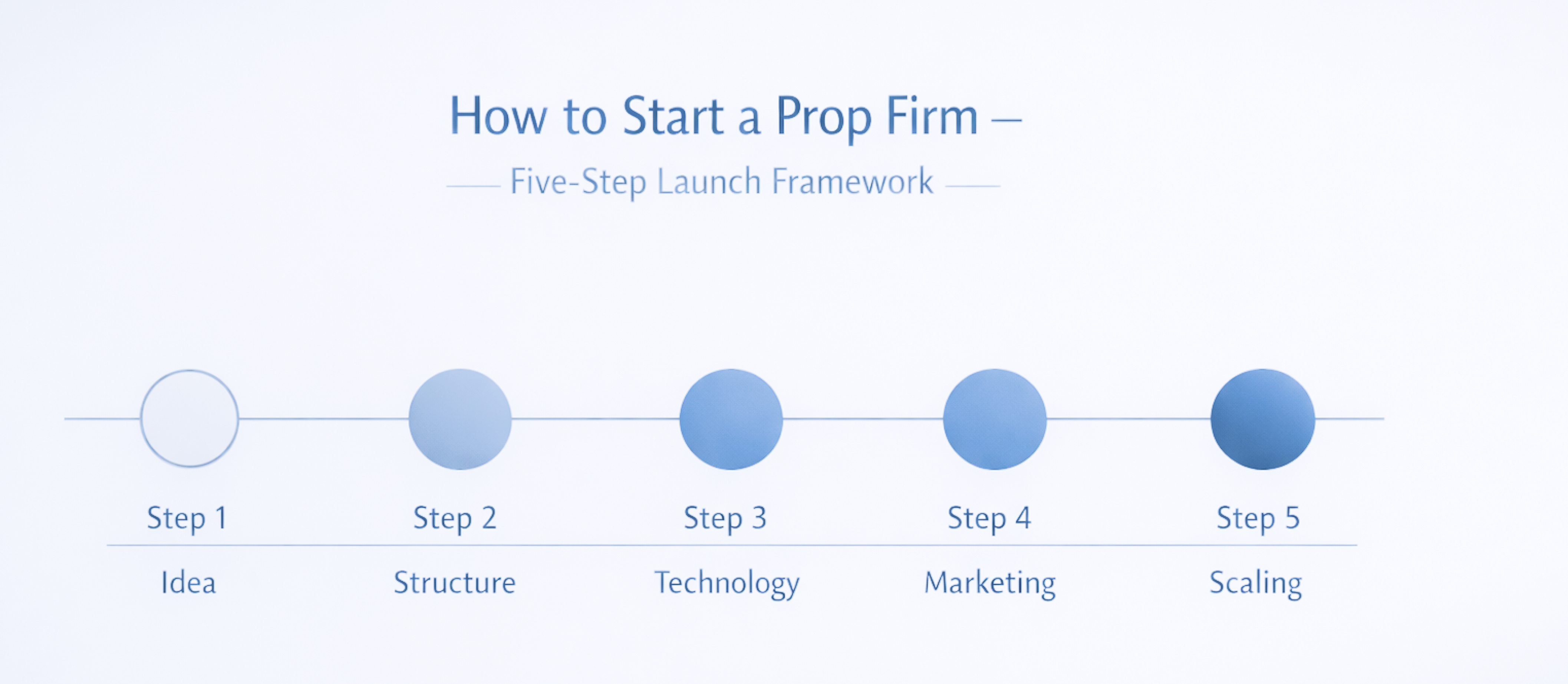
Choose Your Business Model
Your business model defines your revenue profile, risk exposure, and trader appeal. Most firms in 2026 use challenge-based structures, though hybrids are increasingly common.
Challenge-Based Models
These remain the dominant format.
Traders pay an evaluation fee. If they pass predefined profit targets within drawdown limits, they receive a funded account with a profit split.
- 1-Phase challenge
- 2-Phase challenge
- Scaling plans after funding
These models provide predictable revenue through challenge fees.
Instant Funding Models
In this structure, traders skip evaluation and receive capital immediately for a higher upfront fee.
This appeals to experienced traders but increases firm-side risk.
Hybrid Models
- Traditional evaluation accounts
- Instant funding options
- Scaling programs post-funding
Hybrid structures broaden market appeal and diversify revenue streams.
Revenue Streams in 2026
- Challenge fees (primary revenue driver)
- Paid Trading Competitions
- Add-ons such as education or scaling upgrades
Challenge fees remain the core economic engine for most firms.
Legal & Compliance Setup
No full broker license is required in many jurisdictions for pure prop or funded trader models, as firms are not managing client funds.
- UAE free zones (such as DMCC or IFZA)
- Cyprus for European access
- US LLC structures, particularly for futures-focused models
- KYC/AML verification
- Transparent challenge rules
- Clear marketing claims
- Documented payout processes
In 2026, transparency is a competitive advantage. Firms that clearly display rules, risk parameters, and payout proofs tend to build stronger trust.
Budget between $5,000 and $20,000 for legal formation and basic compliance setup, depending on jurisdiction.
Technology Stack Essentials
Technology is the single biggest accelerator when launching a prop firm in 2026.
Custom builds can take 6–18 months. Modular platforms can launch in 2–8 weeks, even less in TradeBrix’s case.
But the difference is not just speed. It is operational control.
In 2026, infrastructure decisions made at launch determine whether a firm scales smoothly, or becomes trapped in operational complexity six months later.
Core Systems You Need
- CRM for trader management/onboarding.
- Real-time dashboards & risk engine.
- Challenge monitoring & auto-enforcement.
- Payout automation (crypto/fiat).
- Integrations: MT5/cTrader, broker APIs, wallets.
TradeBrix PropBrix stands out: modular CRM, AI dashboards, risk tools, full crypto/futures support, scalable to 10k+ traders.
Why Unified Infrastructure Matters
- One tool for KYC
- Another for wallets
- A third for support tickets
- A separate affiliate platform
- Manual spreadsheets for payouts
This creates operational friction and limits scalability.
TradeBrix’s PropBrix is built to centralize the full trader lifecycle inside one unified CRM environment.
- Integrated checkout and payments
- Unified wallet management
- Built-in affiliate tracking
- Risk and monitoring dashboards
- Support ticketing
- Broker and trading platform integrations
Instead of relying on siloed systems, firms operate from a single backend. That reduces errors, lowers operational overhead, and makes scaling beyond 10,000 traders realistic.
For startups, this prevents technical debt from day one.
For scaling firms, it removes inefficiencies that compound over time.
Challenge & Risk Design
Your challenge rules define both your brand reputation and your long-term economics.
- High support volume
- Trader frustration
- Low retention
- Weak referrals
Well-designed rules balance trader opportunity with firm protection.
Recommended Benchmarks for 2026
- Profit targets: 8–10% (avoid 15%+ that kill pass rates).
- Daily drawdown limits: 4–6%
- Maximum drawdown: 10–12%
- Fixed drawdown structures preferred over trailing
Avoid unrealistic targets above 15%. They may look safe and reduce pass rates but damage trust.
Clear rule documentation matters. Ambiguity increases disputes and operational friction.
Using automated monitoring systems ensures rules are enforced consistently and transparently.
Marketing Launch Plan
Launching lean is critical.
In early stages, focus on controlled growth rather than volume at any cost.
Early Acquisition Channels
- SEO content targeting high-intent searches
- Educational YouTube content
- Niche trading communities
- Affiliate partnerships
Affiliate commissions between 15–20% remain standard in 2026.
Avoid over-reliance on paid ads in the early phase unless your economics are fully validated.
Initial marketing budgets typically range between $5,000 and $15,000 per month depending on scope.
Scaling & Payout Operations
- 50–100 traders in initial testing phase
- Controlled marketing push
- Close monitoring of pass rates
Automate payouts from the beginning.
Crypto payouts remain popular due to speed. However, multi-method options improve accessibility.
- Capital increases after profit milestones
- Structured loyalty bonuses
- Educational support to improve trader retention
- Discounts on challenge retries after failing
Target retention rates between 20–40% depending on your model.
Retention is what separates sustainable firms from short-term operators.
Conclusion
Starting a prop firm in 2026 is not only realistic but highly achievable with the right structure and infrastructure in place. Build it correctly from day one, centralize your operations, and scale with discipline.
Book a demo with TradeBrix to see how you can launch faster and operate from a unified platform.
Featured resources

Introducing Our Rewards System: Powering the Next Phase of Prop Firm Growth
Discover how TradeBrix’s new Rewards Points System helps prop firms increase conversions, improve retention, and scale sustainably without relying on heavy discounts.


How to Start a Prop Firm in 2026: Step-by-Step Guide with Tech Essentials
Step-by-step 2026 guide to launching a prop firm: market opportunity, business models, compliance, technology stack, challenges, marketing, payouts, and scaling with TradeBrix.

The Role of Dashboards in Prop Firm Success: Features to Look for in 2026
Discover why prop firm dashboards matter in 2026, key admin and trader features to look for, and how PropBrix by TradeBrix delivers real-time risk visibility at scale.

Legal Compliance for Prop Firms in 2026: Navigating Regulatory Reality Without Slowing Growth
2026 guide to prop firm compliance: KYC/AML, marketing rules, jurisdiction choices, payout transparency, and how PropBrix by TradeBrix simplifies compliance at scale.