

 TradeBrix
 February 12, 2026
 5 min read
Legal Compliance for Prop Firms in 2026: Navigating Regulatory Reality Without Slowing Growth
Legal Compliance for Prop Firms in 2026: Navigating Regulatory Reality Without Slowing Growth

Introduction
Legal compliance has become one of the defining challenges for prop firms operating in 2026.
Over the past several years, the proprietary trading industry has expanded rapidly, with thousands of funded trader programs launching globally. At the same time, regulatory scrutiny has increased. Authorities in the United States, the European Union, and the United Kingdom have paid closer attention to marketing claims, futures-related structures, KYC standards, and representations around payouts and performance.
While most pure evaluation-based prop firms do not custody client funds and therefore often fall outside traditional broker licensing frameworks, that does not mean they operate outside regulatory expectations. Regulators increasingly focus on substance over labels — examining how firms market themselves, how they handle identity verification, and how transparent their rule enforcement truly is.
In this environment, compliance is no longer a legal formality. It is part of operational credibility.
Firms that embed structured KYC workflows, disciplined marketing language, clear disclosures, and centralized recordkeeping into their infrastructure position themselves for longevity. Those that treat compliance as an afterthought expose themselves to avoidable risk.
This guide outlines the regulatory realities facing prop firms in 2026, the core compliance requirements operators must address, jurisdictional considerations, and how PropBrix by TradeBrix helps firms integrate compliance into daily operations without slowing growth.
Understanding the Regulatory Landscape
Prop firms operate in a structurally complex space. They are not traditional brokers. They typically do not custody client funds. Yet they resemble investment services in certain functional ways.
Regulatory attention is increasingly focused less on labels and more on operational substance.
United States
- Futures-based models
- Marketing claims implying guaranteed profits
- Performance representations
- Anti-money laundering compliance
Regulators may examine whether certain structures resemble regulated investment arrangements depending on capital flow and control. Clear disclosures and disciplined marketing language reduce exposure.
European Union
Within EU jurisdictions, financial promotions must remain fair, clear, and non-misleading. Risk disclosures must be presented clearly and not buried in fine print.
While prop firms are not automatically classified as CFD brokers, aggressive or exaggerated advertising can attract regulatory attention. Balanced communication is essential.
United Kingdom
The FCA maintains strict standards around financial promotions. Firms must ensure communications are transparent and substantiated.
Where firms operate evaluation models based on simulated funds, this must be stated clearly across websites, disclaimers, and marketing communications to avoid misleading representations.
UAE, Cyprus, Seychelles
These jurisdictions remain popular for incorporation due to relatively lighter licensing burdens for pure evaluation-based models.
- KYC and AML procedures are mandatory
- Sanctions screening is required
- Record retention standards apply
- International cooperation between regulators is increasing
“Light-touch” does not mean “no compliance.
Core Compliance Requirements
KYC and AML
Identity verification is mandatory across most jurisdictions.
- Verify government-issued identification
- Conduct sanctions screening
- Maintain transaction monitoring
- Retain records for regulatory review
Automation significantly reduces compliance errors and manual workload.
Transparent Rules and Marketing
- Profit targets
- Drawdown structure
- Profit splits
- Trading restrictions
Marketing language should avoid implying guaranteed profits or risk-free outcomes. Balanced communication protects both reputation and longevity.
Payout Transparency
There is no universal mandate requiring public payout leaderboards. However, structured payout transparency improves credibility.
- Aggregated payout summaries
- Clear timelines
- Documented withdrawal processes
Misrepresentation carries more risk than modest disclosure.
Data Protection
- Explicit data consent
- Secure data storage
- Breach notification procedures
Data protection failures often create greater liability than trading losses.
Jurisdictional Snapshot
| Jurisdiction | KYC/AML Required | Marketing Scrutiny | License for Pure Prop |
|---|---|---|---|
| United States | Yes (Enhanced) | High | Typically No (structure dependent) |
| European Union | Yes | Very High | Typically No |
| United Kingdom | Yes | High | Typically No |
| UAE / Cyprus | Yes | Moderate | Typically No |
| Seychelles | Yes | Moderate | Typically No |
Licensing requirements depend on business structure, custody of funds, and local interpretation.
Implementing Compliance Without Slowing Growth
Compliance does not need to become operational friction.
- Incorporating in a jurisdiction aligned with your structure
- Automating identity verification and sanctions screening
- Embedding disclosures into onboarding flows
- Maintaining timestamped audit logs
- Reviewing marketing language regularly
- Training staff on compliance fundamentals
When compliance processes are integrated into infrastructure, they require less manual oversight.
How PropBrix Supports Compliance Infrastructure
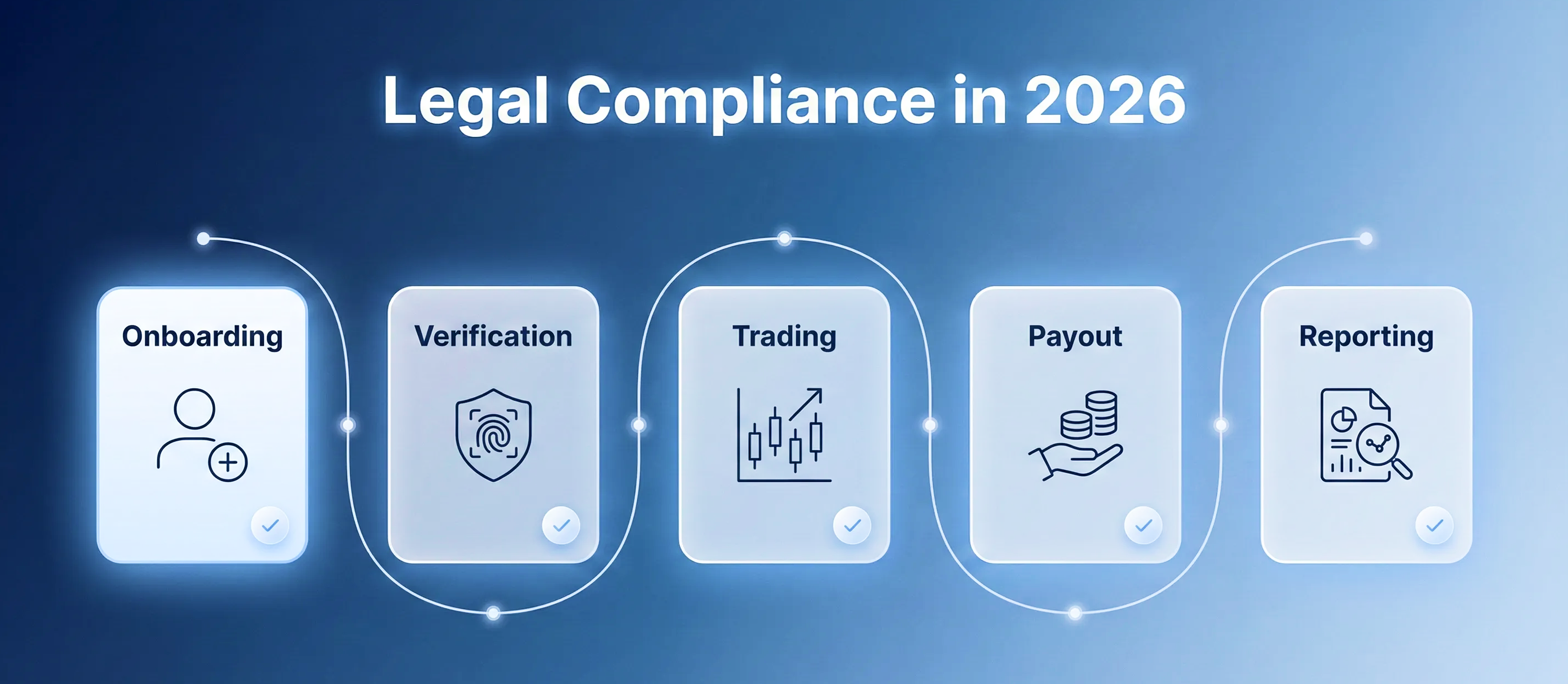
PropBrix by TradeBrix integrates compliance workflows directly into daily operations.
Integrated Identity Verification
Onboarding includes automated identity verification and sanctions screening, reducing manual review.
Embedded Disclosures
Mandatory rule acknowledgments and risk confirmations can be built directly into challenge purchase flows.
Audit-Ready Records
Account creation, breach events, and payout activity are timestamped and exportable, supporting structured documentation if scrutiny arises.
Structured Rule Enforcement
Challenge parameters are consistently enforced across the system, reducing ambiguity and dispute risk.
Centralized Reporting
Operators can generate payout summaries and compliance documentation from one unified backend.
Compliance becomes operational discipline rather than an external burden.
Common Compliance Mistakes
- Overpromising in marketing materials.
- Failing to screen restricted jurisdictions.
- Inconsistent enforcement of documented rules.
- Weak record retention.
- Treating compliance as reactive instead of embedded.
- Most issues arise from operational gaps, not regulatory complexity.
Conclusion
Compliance in 2026 is part of running a serious prop firm. Clear disclosures, structured KYC, disciplined marketing, and centralized recordkeeping protect both reputation and longevity.
PropBrix by TradeBrix embeds these controls directly into your operational workflow so compliance supports growth rather than slowing it.
Book a demo with TradeBrix to see how structured compliance can be managed efficiently at scale.
Featured resources

Introducing Our Rewards System: Powering the Next Phase of Prop Firm Growth
Discover how TradeBrix’s new Rewards Points System helps prop firms increase conversions, improve retention, and scale sustainably without relying on heavy discounts.


How to Start a Prop Firm in 2026: Step-by-Step Guide with Tech Essentials
Step-by-step 2026 guide to launching a prop firm: market opportunity, business models, compliance, technology stack, challenges, marketing, payouts, and scaling with TradeBrix.

The Role of Dashboards in Prop Firm Success: Features to Look for in 2026
Discover why prop firm dashboards matter in 2026, key admin and trader features to look for, and how PropBrix by TradeBrix delivers real-time risk visibility at scale.

Legal Compliance for Prop Firms in 2026: Navigating Regulatory Reality Without Slowing Growth
2026 guide to prop firm compliance: KYC/AML, marketing rules, jurisdiction choices, payout transparency, and how PropBrix by TradeBrix simplifies compliance at scale.