

 TradeBrix
 January 1, 1970
 6 min read
Top Trends in Prop Firm Technology for 2026: From Crypto to AI Integration
Top Trends in Prop Firm Technology for 2026: From Crypto to AI Integration

Introduction
By 2026, prop firm technology has moved far beyond basic white-label platforms and simple challenge engines.
Firms that strengthened their infrastructure after the 2025 consolidation now operate differently. They rely on predictive analytics rather than reactive alerts. They integrate cleanly with brokers and execution providers instead of stitching together middleware. They automate compliance workflows instead of reconciling spreadsheets. And they build systems capable of supporting 10,000 or more active traders without operational strain.
Technology is no longer a background decision. It directly affects exposure control, retention, payout reliability, and long-term sustainability.
This article outlines the most important prop firm technology trends shaping 2026, why each matters operationally, and how PropBrix by TradeBrix aligns with the direction the industry is moving.
AI-Supported Risk Visibility and Trader Scoring
One of the most meaningful shifts in 2026 is the move from reactive breach alerts to predictive risk visibility.
Modern systems analyze trade frequency, position sizing patterns, volatility exposure, and event-driven behavior to surface elevated risk before rules are violated.
The objective is not eliminating breaches. Breaches are part of the structure. The objective is consistent enforcement supported by earlier visibility into risk shifts.
In structured environments, AI can reduce manual monitoring workload significantly, sometimes by 70 to 90 percent, while improving enforcement consistency across accounts.
Some firms also apply trader scoring frameworks to identify disciplined participants who may qualify for scaling opportunities sooner.
AI strengthens oversight. It does not soften risk controls.
Structured Broker and Futures Integrations
Futures participation continues to grow in 2026, particularly among firms targeting US-based traders.
What matters is not whether a firm claims to “offer futures,” but whether its infrastructure integrates cleanly with futures brokers and execution feeds. Direct integrations with clearing firms and market data providers improve reporting accuracy and simplify reconciliation.
Futures support is about broker connectivity and execution infrastructure. It is separate from wallet or payout functionality.
Firms relying on fragile middleware or manual export processes often encounter operational friction as trader volume grows.
Clean broker integration reduces complexity.
Integrated Wallet Infrastructure and Crypto Payouts
Crypto payouts have moved from novelty to expectation.
Many firms now support stablecoin withdrawals such as USDT or USDC alongside traditional fiat rails. When wallet infrastructure is built directly into the trader and admin dashboard, internal balances, evaluation fees, and profit share distributions can be managed transparently.
Wallet systems handle internal ledgering and payout flows. They do not execute trades or manage market exposure.
In some cases, crypto withdrawals can be processed very quickly depending on internal review procedures and network conditions. Consistency and auditability matter more than speed claims.
Integrated wallet infrastructure reduces manual payout handling and improves operational clarity.
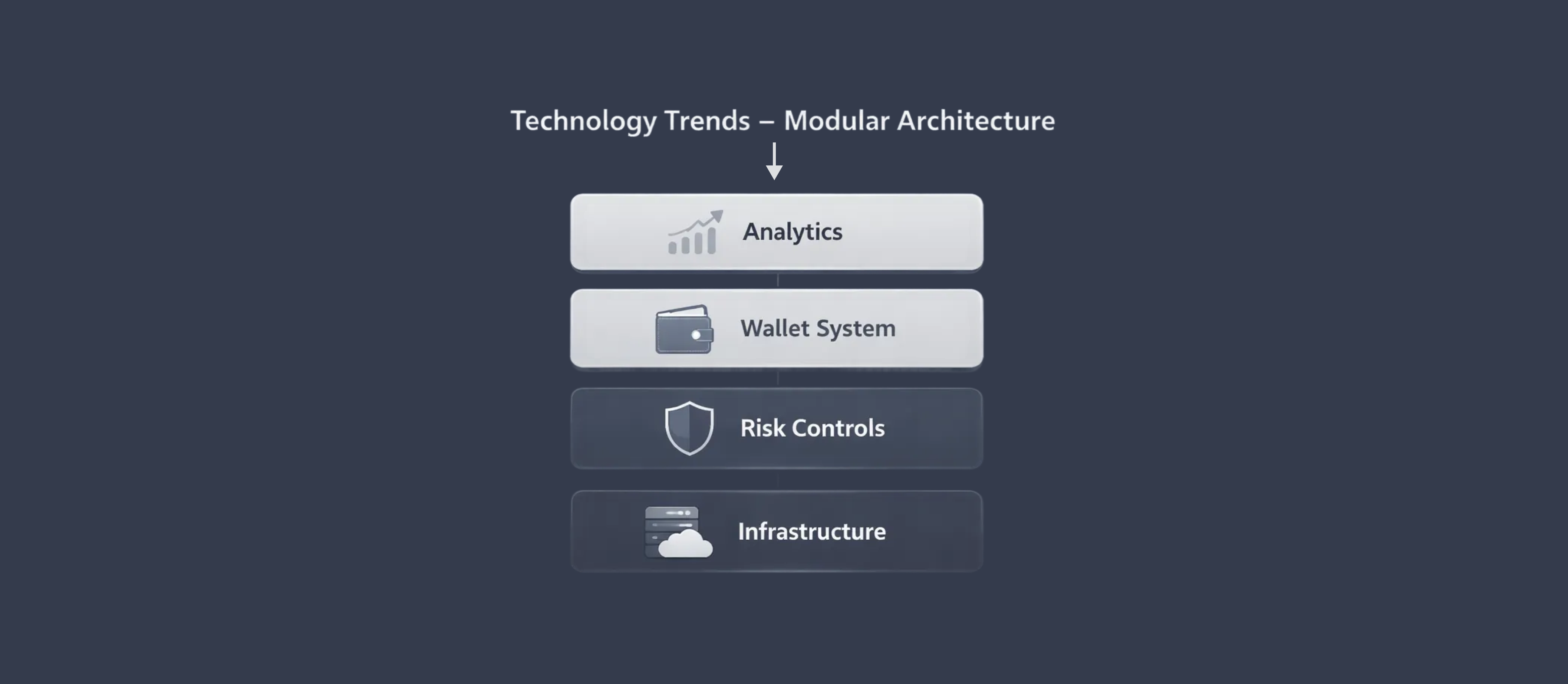
Modular and Composable Architecture
Rigid systems limit growth.
Leading firms increasingly expect modular platforms where new rule types, account structures, or asset classes can be introduced without rebuilding the backend.
- Brokers
- Payment processors
- KYC providers
- Analytics systems
Horizontal cloud scaling allows firms to support 10,000 or more active traders without performance degradation.
Infrastructure flexibility determines how quickly a firm can respond to market shifts or regulatory changes.
Localization and Multi-Regional Expansion
Global growth in 2026 requires more than an English-only interface.
- Arabic, Spanish, Hindi, and Portuguese language support
- Region-specific onboarding adjustments
- Local payment gateways supporting AED, BRL, INR, and other currencies
Localization requires structural consideration, not just translation. Rule clarity, payout expectations, and support workflows often need regional adaptation.
Firms that localize thoughtfully tend to see stronger traction in non-English markets.
Advanced Trader Experience and Retention Tools
Technology now plays a direct role in retention.
- Clear drawdown visibility
- Structured progress tracking
- Performance summaries
- Mobile-optimized interfaces
In many environments, a majority of trader logins occur on mobile devices. Responsive design is therefore foundational.
Some platforms introduce behavioral prompts based on trading patterns. These tools are designed to reinforce discipline and clarity, not to gamify excessive risk.
Retention improves when expectations are transparent.
Compliance Automation and Audit Readiness
As scrutiny increases, documentation standards are rising.
- Integrated KYC and sanctions screening
- Structured audit logs for trader and admin actions
- Clear payout records
- Exportable compliance reports
Automation reduces manual workload and lowers the risk of reporting errors.
Clear documentation supports operational stability.
Trend Overview
| Trend | Why It Matters | Operational Impact |
|---|---|---|
| AI Risk Visibility | Earlier exposure detection | Reduced manual monitoring |
| Broker Intergrations | Clean execution connectivity | Fewer reconciliation issues |
| Wallet Infrastructure | Transparent payout handling | Reduced manual payout workload |
| Modular architecture | Faster adaptation | Scalable growth |
| Localization | Regional expansion | Improved global penetration |
| Retention Tooling | Clear trader visibility | Stronger funded continuity |
| Compliance Automation | Audit readiness | Lower operational friction |
How PropBrix Aligns with 2026 Infrastructure Needs
PropBrix by TradeBrix was designed around integrated infrastructure rather than layered add-ons.
- Structured broker integrations
- Integrated wallet and payout infrastructure
- AI-enhanced risk visibility
- Centralized onboarding and KYC workflows
- Modular architecture for rule and asset expansion
- Infrastructure capable of supporting 10,000 or more active traders
Instead of combining disconnected systems for monitoring, payouts, onboarding, and referrals, firms manage the full trader lifecycle inside one operational environment.
That consolidation improves clarity and reduces reconciliation friction as scale increases.
What to Evaluate When Choosing Technology in 2026
- Are broker and execution integrations structured properly, or layered through fragile workarounds?
- Is wallet and payout functionality built directly into the platform, or dependent on disconnected third-party tools?
- Does the system provide predictive risk visibility rather than only reactive alerts?
- Can new rule types or account structures be added without rebuilding the core infrastructure?
- Is localization embedded or treated as an afterthought?
- Are compliance logs structured and easily accessible?
Technology decisions compound over time. Choosing flexible infrastructure early reduces operational bottlenecks later.
Conclusion
Prop firm technology in 2026 is defined by predictive risk visibility, structured broker integrations, integrated wallet infrastructure, modular design, localization capability, and compliance automation.
Firms aligning infrastructure with these trends position themselves for sustainable growth. PropBrix by TradeBrix brings these components together inside one unified system, helping founders building long-term firms scale with clarity and operational control.
Book a demo with TradeBrix to explore how modern prop firm infrastructure performs in practice.
Featured resources

Introducing Our Rewards System: Powering the Next Phase of Prop Firm Growth
Discover how TradeBrix’s new Rewards Points System helps prop firms increase conversions, improve retention, and scale sustainably without relying on heavy discounts.


How to Start a Prop Firm in 2026: Step-by-Step Guide with Tech Essentials
Step-by-step 2026 guide to launching a prop firm: market opportunity, business models, compliance, technology stack, challenges, marketing, payouts, and scaling with TradeBrix.

The Role of Dashboards in Prop Firm Success: Features to Look for in 2026
Discover why prop firm dashboards matter in 2026, key admin and trader features to look for, and how PropBrix by TradeBrix delivers real-time risk visibility at scale.

Legal Compliance for Prop Firms in 2026: Navigating Regulatory Reality Without Slowing Growth
2026 guide to prop firm compliance: KYC/AML, marketing rules, jurisdiction choices, payout transparency, and how PropBrix by TradeBrix simplifies compliance at scale.