


 TradeBrix
 January 15, 2026
 6 min read
Understanding Proprietary Trading: A Beginner’s Guide for 2026 Firm Owners
Understanding Proprietary Trading: A Beginner’s Guide for 2026 Firm Owners

Introduction
In 2026, proprietary trading remains one of the most visible routes for retail traders to access larger capital without risking their own deposits. For those considering launching a firm, however, the opportunity looks very different behind the scenes.
Building a prop firm is not simply about offering large account sizes and attractive profit splits. It requires a clear understanding of evaluation mechanics, risk exposure, payout structures, trader psychology, compliance positioning, and operational infrastructure from the outset.
This guide breaks down how the modern prop trading model works, the primary structures used in 2026, the benefits and risks for both traders and owners, and why integrated infrastructure such as PropBrix by TradeBrix has become essential for founders building long-term firms.
What Is Proprietary Trading?
In the modern prop firm model, a company allows traders to trade using the firm’s capital rather than their own. To qualify, traders typically complete an evaluation and, if successful, share a portion of profits with the firm.
Traders do not deposit trading capital into the firm. Instead, they pay an evaluation fee for the opportunity to demonstrate consistency under defined rules.
- The trader keeps a predefined share of profits, commonly 80 to 90 percent depending on the firm’s structure.
- The remaining percentage goes to the firm.
- Losses are capped by clearly defined daily and overall drawdown limits.\
- Futures markets
- Forex and CFD markets
- Cryptocurrency pairs\
Evaluation fees vary significantly. Entry-level accounts can start around $20 during promotional periods. Mid-tier challenges commonly fall between $100 and $700, while larger capital allocations may exceed $1,000 depending on account size and scaling model.
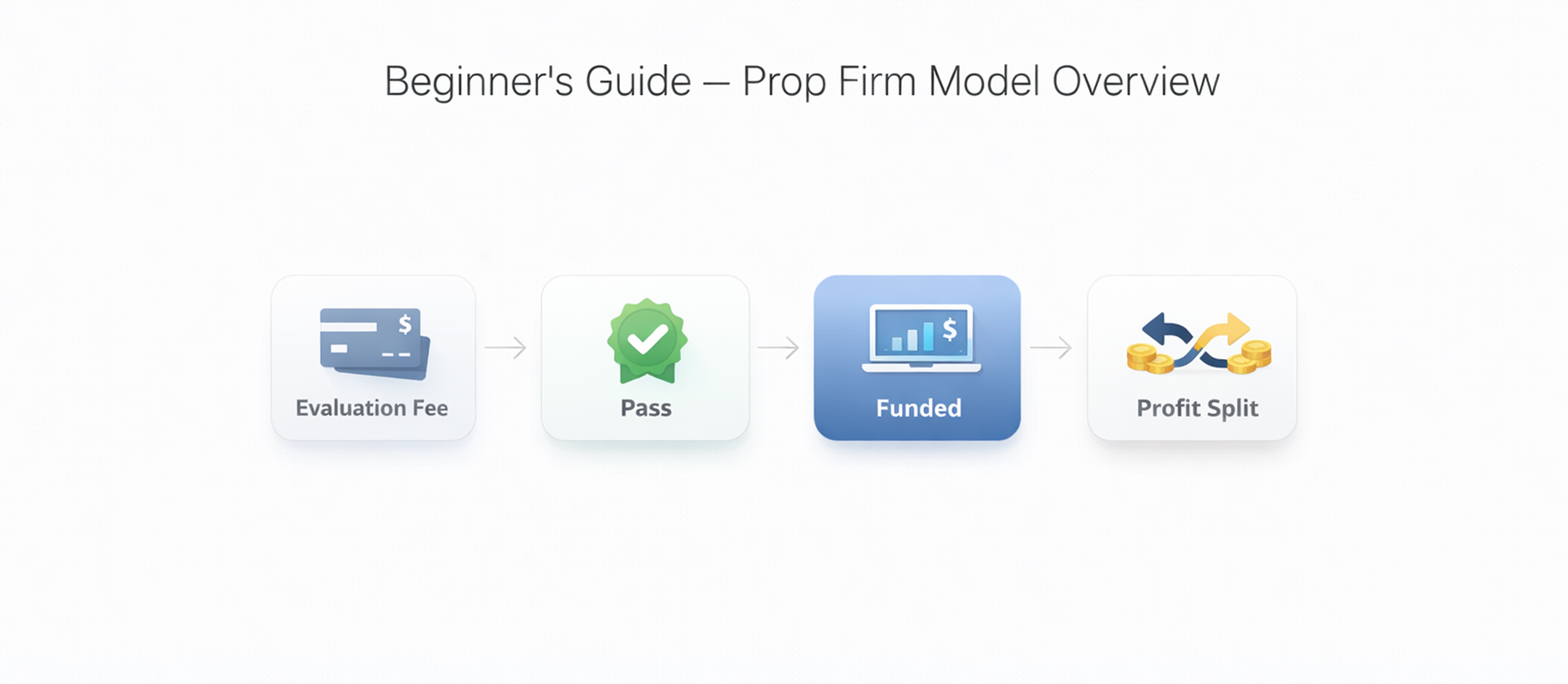
How the Modern Prop Trading Model Works
While the concept appears simple, the structure is carefully designed.
Evaluation Structure
One, two, or even three-phase evaluation models are now common. In each phase, traders must reach a profit target while remaining within predefined drawdown limits and rule constraints.
Industry-wide pass rates typically sit between 5 and 15 percent. Structured firms operating optimized models may reach 15 to 30 percent, depending on rule design and trader profile.
Funded Accounts
Once the evaluation is passed, traders receive access to a funded account operating under similar risk parameters.
Funded balances may begin as low as $5,000 or $10,000 for entry tiers and scale into the hundreds of thousands, sometimes beyond, for traders who demonstrate sustained performance.
Scaling structures vary by firm, but consistent discipline is usually rewarded with larger capital allocations over time.
Profit Split and Payouts
Profit splits are predefined. Many firms offer 80 to 90 percent to the trader, although exact percentages vary. The firm retains the remaining portion.
Firms offering consistent payout processing within 24 to 48 hours tend to build stronger trader confidence than those with unclear or inconsistent timelines.
Predictability matters more than marketing claims.
Main Prop Firm Business Models in 2026
Not all firms structure access the same way.
Challenge-Based Model
The most common structure in today’s market.
Traders complete one, two, or three evaluation phases before receiving funding. Revenue is generated from evaluation fees and profit share from funded traders.
This model provides structured exposure control while remaining scalable.
Instant Funding Model
In instant funding models, traders bypass a traditional evaluation phase. They pay a higher upfront fee and begin trading immediately, typically under tighter drawdown limits.
This appeals to experienced traders who prefer faster access, although risk controls must be designed carefully.
Hybrid Model
Hybrid firms combine structured evaluation challenges with instant funding options and clearly defined scaling pathways. This flexibility can appeal to a broader range of traders and support stronger long-term continuity when managed properly.
Direct Funding
Less common in the retail prop environment, direct funding is usually reserved for traders with documented track records or institutional relationships.
Benefits and Risks for Traders
Benefits
- Access to significantly larger capital
- Limited personal financial exposure
- Structured performance rules
- Opportunity to scale capital over time
Risks
- Evaluation fees are non-refundable if unsuccessful
- Strict drawdown constraints
- Performance pressure
- Income variability
Benefits and Risks for Firm Owners
Benefits
- Scalable business model
- Strong margins when risk is structured correctly
Risks
- Exposure to funded account volatility
- Reputational damage from payout delays
- High churn if trader experience lacks clarity
While they are a fundamental part of the structure, the objective is not just about breaches. The objective is to enforce rules consistently and protect exposure in a predictable way.
Breaches are part of a healthy structure. The objective is balance: consistent enforcement, controlled exposure, and predictable payout dynamics.
Key Trends Shaping 2026
Growing Emphasis on Futures
Increased Transparency Expectations
Traders expect visible payout updates, published pass rate ranges, and structured reporting.
AI-Supported Monitoring
Behavioral analytics and structured monitoring improve enforcement precision and operational efficiency.
Retention Over Raw Volume
Sustainable firms focus on funded trader continuity rather than maximizing challenge signups alone.
Jurisdictional Strategy
Founders increasingly seek professional legal guidance when selecting jurisdiction. In 2026, regions such as the UAE and Cyprus are commonly explored by prop firm founders, although suitability depends entirely on structure and target markets.
Why Infrastructure Is Foundational
Manual processes may function at small scale, but as trader volume grows into the hundreds or thousands, fragmented systems create operational strain.
- Automated onboarding with integrated KYC
- Real-time risk monitoring
- Structured breach enforcement
- Transparent trader dashboards
- Automated payout workflows
- Analytics covering pass rates, retention, and acquisition sources
PropBrix by TradeBrix centralizes these components inside one operational environment. Instead of combining separate tools for onboarding, monitoring, payouts, and referrals, firms manage the full trader lifecycle in a unified system.
This supports consistent enforcement, reduces reconciliation errors, and allows scale without operational chaos.
Practical Advice for New Firm Owners
- Start with a focused challenge structure rather than launching multiple variations at once.
- Share regular payout updates and publish pass rate ranges early to build trust.
- Design rules that are strict but easy to understand. Confusion increases churn.
- Invest in infrastructure before scaling marketing spend.
- Seek legal advice aligned with your chosen jurisdiction.
- Build community steadily. Growth compounds when trust and clarity are consistent.
Conclusion
Proprietary trading in 2026 offers meaningful opportunity for both traders and founders building long-term firms. The model works when risk is structured, rules are transparent, payouts are predictable, and infrastructure supports scale.
PropBrix by TradeBrix provides the operational backbone that allows new firms to launch confidently and grow sustainably in a more mature industry.
Book a demo with TradeBrix to explore how modern prop firm infrastructure operates in practice.\